Cherry Audio has released Pentaphonic, a virtual synthesizer for Mac & Windows that is based on the rare Gleeman Pentaphonic, an early-1980s hybrid instrument.
The original Pentaphonic combined five-voice polyphony, three digitally controlled oscillators per voice, analog filtering and a built-in sequencer.
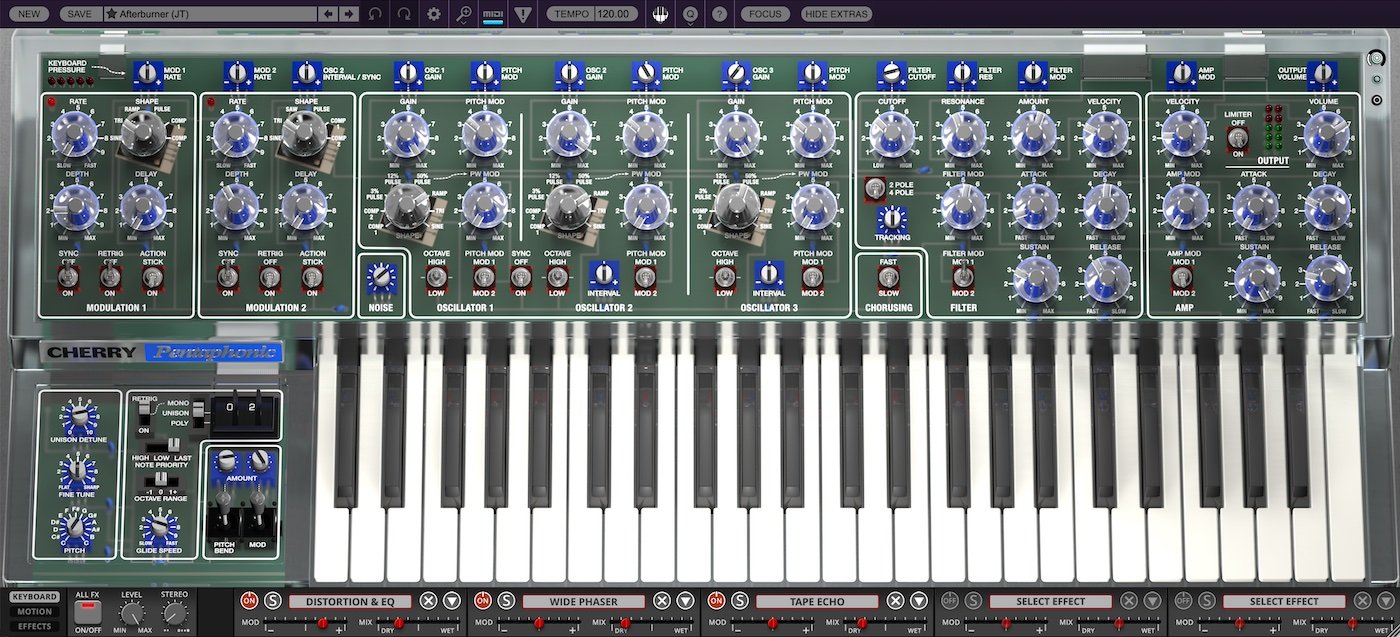
Cherry Audio has preserved that basic architecture, while adding capabilities that weren’t available on the original hardware, including expanded polyphony, oscillator sync, pulse-width modulation, additional modulation sources, expressive keyboard control, a modern sequencer and an extensive effects section.
Features:
- Three oscillators per voice retain the original’s distinctive set of eight waveforms, including the Complex 1 and Complex 2 waves.
- Polyphony expands from the original five voices to 2–16 voices, with unison and mono modes also available.
- Cherry Audio adds pulse-width modulation, a noise generator and oscillator sync.
- Two expanded modulation/LFO sections provide additional control over oscillator, filter and amplifier parameters.
- Both modulation sections can use the eight oscillator waveform shapes rather than being limited to the original triangle-wave LFO.
- The filter retains the original 4-pole, 24 dB-per-octave low-pass design while adding a 2-pole, 12 dB-per-octave mode and keyboard tracking.
- Velocity can control filter and amplifier response.
- Channel and polyphonic aftertouch provide expressive control, with 14 parameters available for keyboard-pressure modulation.
- A dedicated modulation stick and assignable pitch-bend range expand the performance controls.
- The dynamic arpeggiator includes Arp, Leap, Order and Random modes, along with swing, chance and feel controls.
- A syncable and transposable 16×4 polyphonic step sequencer adds humanization and DAW synchronization.
- The Parameter Animator provides another 16-step modulation source for cutoff, resonance, oscillator pitch modulation and oscillator gain.
- The original chorus is joined by a global effects system offering 22 effects, with up to five effects arranged in a chain.
- Three interface themes recreate different stages of the Pentaphonic’s visual history, including black and transparent designs with adjustable opacity.
- The instrument includes more than 375 presets across 14 categories, including the original 50 factory patches.
- Pentaphonic supports complete MIDI control and DAW automation, along with MIDI Learn.
- The instrument is available as a standalone application and as AU, VST, VST3 and AAX plug-ins.
Pricing & Availability:
Cherry Audio Pentaphonic is available now for $59.

The acrylic GUI skins are the Best of Breed so far this year. It was a tough synth for the time, with a more industrial internal standard. It was expensive because it didn’t cut corners. It included two processors that shared the operating load, which was a big deal at the time. It was much more stable as a result. Its a lost sheep from the past. It deserves a hearing. It has an interesting voice.
It’s a shame it’s a cherry audio synth. Their stuff is aliasing garbage.
It really isn’t, and hasn’t been for about 5 years. All their plugins use 16x internal oversampling
We’ll all just use one of the other Gleeman Pentaphonic VSTs then! Or we could just turn on oversampling.
Its great it is a Cherry Audio synth, great price and no aliasing (I have had my ears syringed, 2 weeks ago)
They should slowly turn yellow the longer you own the plugin
Somebody fetch a wet vac. Mr. Burns has an impacted heiney. :O
Aliasing, poor contrast, tiny fonts, Cherry Audio’s GUIs are so awful and poorly designed on all their synths. It’s a shame cause I think they really have a catalog of unique instruments, but man visually it’s torture and migraine fuel. (and they know it, they even have to have a magnify zoom feature to mitigate the visual issues)
Their demos always end up in the trash for me because of that.
$59 bucks for a software emulation of a synth I could only dream of owning back when it came out? Pinch me. Of course, the real holy grail for me would be a full blown full featured emulation of a McLeyvier, but I can’t imagine any soft synth developer would be so foolhardy to attempt it, so for the time being I’ll take anything Cherry Audio puts out there – (alleged) aliasing be damned.
Every Cherry Audio VST I bought sounds the same. Like they’re using same DSP algorithm wrapped in a different GUI with different EQ settings.