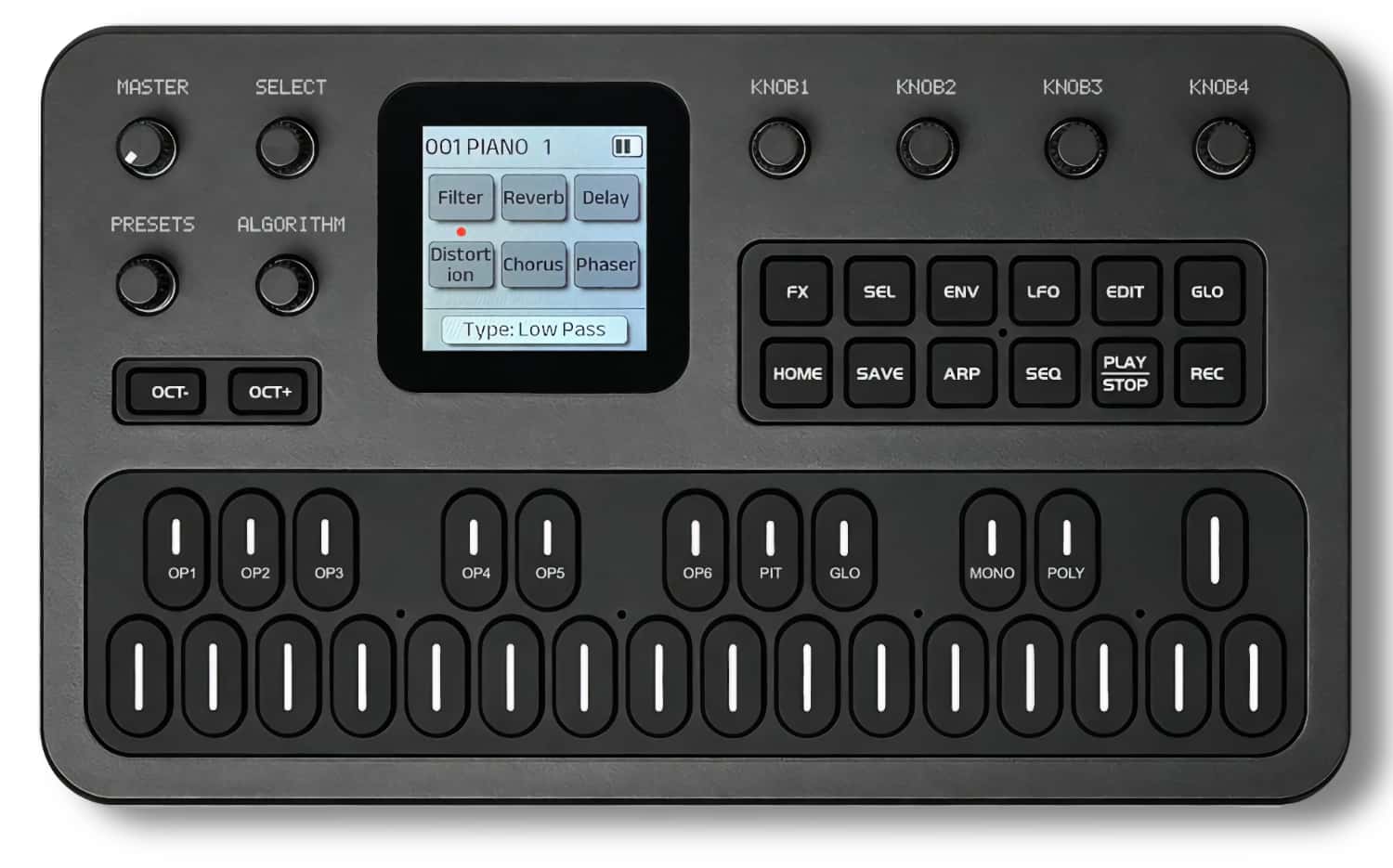
M-VAVE is officially embracing the explosion of alternate firmware for its compact FM-1 synthesizer by introducing FM1 Open, an official open-source firmware project.
The release includes an open firmware, a browser-based workbench for editing sounds and projects, and a software development kit intended to help users and developers create new applications for the hardware.
The announcement follows a growing community of third-party developers who have released alternate firmware for the inexpensive synth, transforming the FM-1 into a popular development platform. Rather than limiting development to unofficial projects, M-VAVE is providing its own framework for extending the instrument’s capabilities.The open firmware features:
- Eight-track sequencer for arranging melodies, bass lines, percussion and samples.
- Multiple sound engines, including DX7-style FM synthesis and sample playback.
- Additional synthesis options including 303-style, 808-style, PSG and plucked-string sounds.
- Independent sound settings and volume controls for each track.
- Per-track loop lengths, with mute and solo functions.
- Reverb and delay sends for track-level effects routing.
- Eight sample slots for incorporating custom audio.
- Browser-based workbench for editing sounds, patterns and projects.
- Browser-based preview that allows users to explore the interface without connecting an FM-1.
- Tools for managing samples and transferring projects to compatible hardware.
- Firmware flashing through the workbench.
- Application source code and a companion software development kit for developers.
- Support for building and extending FM-1 applications, subject to the project’s source and SDK terms.
Availability:
FM1 Open is available as a free firmware and development project from M-VAVE. The source code is available now on GitHub.

They surely see what’s happening with their sales, so this is a smart move. Make the cheap hardware, let the community do the programming.
This is the future: putting out versatile hardware to match a price point, giving users some good basic tools out of the box, and leaving the hardware unlocked so technically inclined musicians can repurpose it. The money from now on is in manufacturing with consistency and good QC, and a nice physical user interface that’s flexible enough for others to use. M-VAVE really have th balance right: a nice screen, enough micro-encoders to have music options without trippng your fingers, 16 steps on the white keys, and 12 mode buttons. Their pro/elite mini-keys keyboards offer more and larger knobs plus some faders, while keeping the same basic architecture.I’m really happy to see this cheap and cheerful little synth break out and become an overnight success.
But your romantic vision runs up against the fact that this would lead to a reduction in the money supply within the industry, cause many players to leave the market, and result in a decline in the stability of the instruments due to inconsistencies in development. Community-supported custom firmware is good for showing manufacturers exactly what features users expect to see, but it’s not suitable for serious use by studio and concert musicians.
People with a certain anti-corporate mindset are rejoicing right now, but the problem is that none of them feel the urge to pick up a calculator and figure out exactly how the economics of musical instrument production work, and why their desire to push manufacturers toward open development platforms clashes with a sustainable economic model of production and labor compensation.
Overall, if you’re satisfied with a world where you own products whose build quality matches that of the FM1, and you accept that manufacturers will refuse to provide any support for devices beyond physical manufacturing defects, then this might work.
Studio and concert musicians? I live in Nashville. I get what you’re saying, but think about how many people AREN’T studio or concert musicians, even in Nashville these days. Regular folks made banjos before Gibson, and they’re STILL making them all these years later. I think what you’re seeing with this device is unstoppable. It seems to happen with almost everything.
Professionals keep buying Nords. There have been so many cheap microphones for so many years now, but people still buy Schoeps. If some of the major synth makers disappear, I think it’s easier than ever for someone to take their place and make some really good gear.
Yes, I’m optimistic. I’ve been excited ever since the year I was going store to store comparing the DX7, D-50, and M1, but things have gotten real stale lately. This feels and looks like a beautiful evolution. There are plenty of solid synths out there. Apple Logic is also readily available for almost nothing. I think we have room to breathe.
Nigel, that sounds like the thinking of folks before Henry Ford released the Model T.
Lots of car companies made decent but very expensive cars until the Model T killed them off. That extinction event, however, did not end automotive innovation, improvement, and variety. It did allow everybody to drive, and that’s what made the industry into something big and making room for a huge spectrum of choices and prices.
Nigel I dont think you know anything at all about how all these industries work together, therefore your arguments have no merit whatsoever – and there is no point in debating them. But Im sure it feels great for you to know it all, that must be wonderfull
There will always be a market for both cheap hardware and expensive hardware with things like fully weighted 88-key controllers. People will always pay for well engineered hardware and (where needed) solid firmware. Proof of this is that high end analog gear, guitars and other instruments continue to command high prices from professionals and enthusiasts despite the availability of budget options delivering the same basic features. Anyone who plays understands the feel of a quality instrument when they pick it up or put their hands on it.
On the digital side, the secret sauce is in signal chain design and coefficient tuning. Lots of people had the knowledge to DIY that stuff, but were limited to doing so on the software side because of the relative dearth of open hardware. This situation is coming to an end. Markets change and evolve. If people have access to gear with quality encoders, faders, display, keybeds etc and which are also left open for being hacked or modded, they’ll buy them and the hardware manufacturers who offer them will make money.
This s#|t is crazy!!!!
Yeh man.. Im there. Im pumped about their embrace of this
We dream of an Open Source Firmware keyboard Platform now… like a proper keyboard with a proper CPU/RAM with a proper set of controls and screen – with an entirely open firmware
WILL THEY DELIVER THIS?
The M-VAVE SMK-37pro (and others in that line) has the same main chip as the FM-1 and many of the firmwares have been ported to it.
This is fantastic. I was stoked when synthstrom did it but this is in a completely different price range and very cool.
You may want to update this, M-VAVE just put out V16 firmware for the FM-1 turning it in to a 20 voice, 8-part multi-timbral 6-op FM synth with 8 tracks of 64 step sequencing.
After the usual initial burst of interest in the New, I think this will drop down to a level where its just another option. It’ll be like having a small modular rig or tracker over a keyboard setup. It won’t replace more stable, better supported commercial devices, but it will be a useful band member that doesn’t become an acid casualty. Its an interesting new wrinkle for sound designers.
I lost track of the firmware releases…